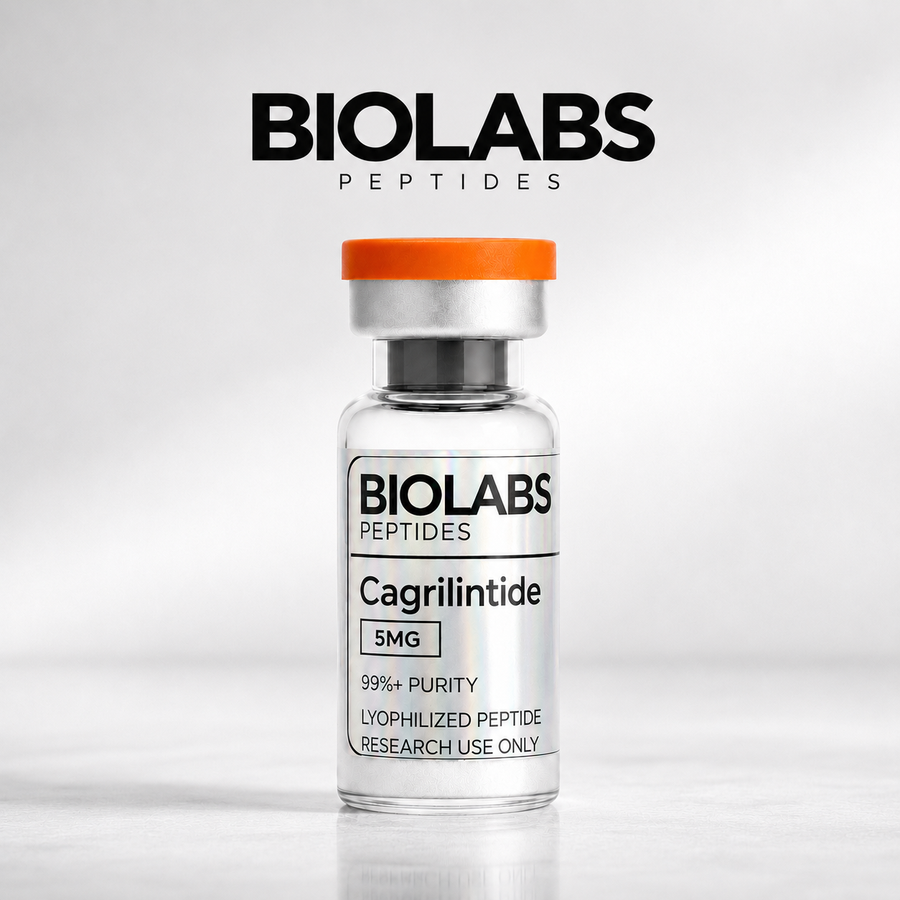
BioLabs
Cagrilintide 5mg
Peptide Name
Cagrilintide (AM833 / NN0174-0833)
Chemical Name/Structure
-
Chemical Name: N-(19-carboxy-1-oxononadecyl)-L-\gamma-glutamyl-L-lysyl-L-cysteinyl-L-asparaginyl-L-threonyl-L-alanyl-L-threonyl-L-cysteinyl-L-alanyl-L-threonyl-L-glutaminyl-L-arginyl-L-leucyl-L-alanyl-L-\alpha-glutamyl-L-phenylalanyl-L-leucyl-L-arginyl-L-histidyl-L-seryl-L-seryl-L-asparaginyl-L-asparaginyl-L-phenylalanylglycyl-L-prolyl-L-isoleucyl-L-leucyl-L-prolyl-L-prolyl-L-threonyl-L-asparaginyl-L-valyl-glycyl-L-seryl-L-asparaginyl-L-threonyl-L-prolinamide
-
Structural Description: Cagrilintide is a synthetic, long-acting acylated analog of human amylin (a 37-amino acid peptide). It is modified with a C_{20 fatty diacid (eicosanedioic acid) conjugated via a hydrophilic glutamic acid linker at the Lysine residue of position 1 to enable robust albumin binding and prolong its research half-life.
-
Molecular Formula: C_{194H_{312N_{54O_{59S_{2
-
Molecular Weight: 4409.01 g/mol
CAS Number
-
CAS Registry Number: 1415456-99-3
Research Areas of Focus
Researchers are actively investigating Cagrilintide across several key metabolic and physiological domains, including:
-
Dual Amylin & Calcitonin Receptor Agonism: Evaluating its nonselective activation of both amylin receptors (AMYR) and calcitonin receptors (CTR) to study downstream neuroendocrine satiety pathways.
-
Synergistic Co-Administration with GLP-1 Agonists: Investigating its additive physiological effects on appetite regulation, caloric intake reduction, and body composition when studied alongside GLP-1 receptor agonists (such as semaglutide).
-
Gastric Emptying and GI Transit Dynamics: Studying its pharmacodynamics concerning delayed gastric transit, postprandial glucose excursions, and gastrointestinal hormone release patterns.
-
Energy Expenditure and Lipid Metabolism: Assessing its contribution to resting metabolic rate, fat oxidation, and adipose tissue signaling cascades in animal models of metabolic syndrome.
-
Homeostatic & Hedonic Satiety Signaling: Exploring how the peptide modulates neuronal activation in both the hindbrain (homeostatic control) and reward-related pathways (hedonic control) to decrease food motivation.
RESEARCH-USE NOTICE
This product is supplied by Biolabs for laboratory and research purposes only. It is not intended to diagnose, treat, cure, or prevent any medical condition and should not be used as a substitute for professional medical advice or treatment.
Any information provided is for general research, product identification, storage, and handling purposes only. The purchaser is responsible for using and storing the product appropriately and in accordance with applicable regulations.
Shipping & Stability Notice
Because our lyophilized (freeze-dried) vials are in a highly stable, solid-powder state, they are robust enough to withstand fluctuating temperatures during transit. Unlike liquid formulations, lyophilized Cagrilintide can safely be shipped under standard shipping conditions without compromising product integrity. If you reside in a regional or remote area where overnight delivery is not guaranteed, we strongly recommend choosing these lyophilized vials to ensure your research materials arrive in perfect condition.
Product Storage & Shelf-Life
At BioLabs, we source and synthesize only the highest-purity compounds to guarantee reliable experimental results. In its lyophilized powder form, Cagrilintide is exceptionally stable. Once received, the vials should be stored in a freezer at -20°C for long-term preservation (up to 3 years) or refrigerated at 2°C to 8°C if they are to be reconstituted and used in active research protocols within 12 months.